
+91-9240214610 (Bandra)
+91-9240214611 (Kandivali)




September 4, 2026 | Author: Admin
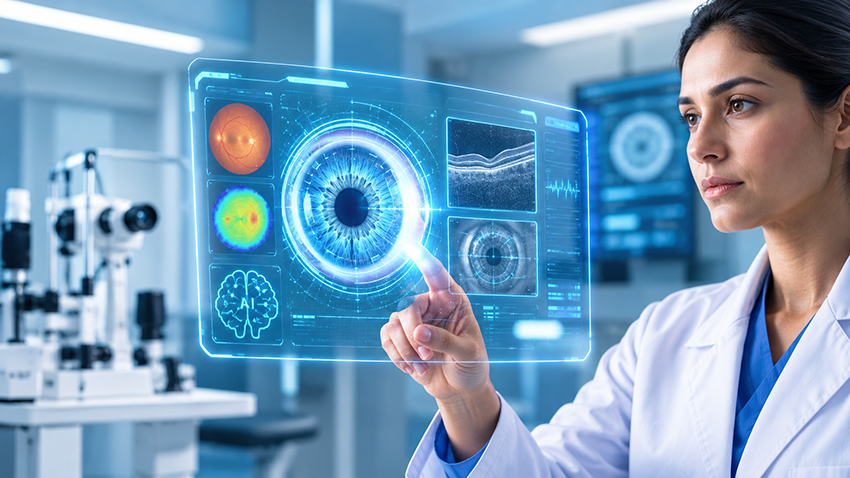
Artificial intelligence or AI, has come out of the tech news channels and entered our lives. And it’s also slowly becoming part of healthcare, including eye care. Ophthalmology is using AI to analyze eye scans, to help screen for diseases and to help doctors spot changes which are not always easy to see. This can be particularly useful in eye conditions where early detection and regular monitoring is important.
But there’s one thing to remember. AI is there to help the eye doctor, not replace the doctor. The final diagnosis and decisions of treatment still depend on a qualified ophthalmologist and proper clinical examination.
AI in ophthalmology is simply the use of computer systems to analyze images of the eye and other medical information. For example, there can be a lot of information in a retinal scan. AI can evaluate these images and look for patterns that could be linked with some eye diseases. It can evaluate this data very fast and help to point out abnormalities the doctor may have missed. This can be useful, because some eye diseases can begin quietly, without noticeable symptoms.
One of the interesting things about AI is that it can analyze large amounts of information in a short time. This can be useful in eye care when doctors are looking at retinal photographs, OCT scans or other eye images. AI is able to detect trends that could indicate a problem and help the doctor determine whether further tests are needed. That doesn’t mean you can just get a report from an AI to find out what treatment you need. Your ophthalmologist still needs to look at your symptoms, medical history, examination findings and test results as a whole.
Diabetes can affect the small blood vessels in the retina and lead to diabetic retinopathy. The concerning part is that retinal changes can sometimes develop before a person notices any problem with their vision. AI can help analyze retinal photographs for signs of diabetic retinopathy. This makes it useful as a screening tool, particularly when there is a large number of people to be screened. The earlier a potential problem is identified, the sooner that individual can be referred to an eye specialist for detailed examination and appropriate treatment.
Glaucoma is another condition where early detection matters. In its initial stages, it may not cause obvious symptoms and vision already lost because of glaucoma generally cannot be restored. Artificial intelligence can assist doctors in analyzing images of the optic nerve and other relevant eye information. It may be useful to identify changes that need more attention. It can also help support monitoring over time. But glaucoma is not diagnosed by a single scan, or a single AI result. An ophthalmologist considers the complete picture before saying whether glaucoma is present and how it should be treated.
Age-related macular degeneration or AMD, affects the macula, the central part of the retina responsible for clear central vision. AI can be used to examine retinal images and identify small changes in the retina. For patients who need regular follow-up, this can help doctors keep a closer watch on how the condition is progressing. This is one area where AI can be particularly helpful because even small changes may be important when monitoring retinal diseases.
AI is also finding a role in planning certain eye procedures. It can assist with things such as lens power calculations, corneal mapping and predicting possible surgical results. These tools can provide additional information that doctors can use while planning cataract or refractive procedures. The aim is to make the planning more individualized rather than following exactly the same approach for every patient.
This is probably one of the most common questions people have. The simple answer is – no, AI can process information quickly, but an eye doctor does much more than analyzing an image. The doctor listens to your concerns, understands your medical history, examines your eyes, interprets the test results and discusses what treatment is appropriate for you.
Two people can even have similar-looking scans but require different approaches because their age, symptoms, medical history or other findings are different. So, it is better to think of AI as another tool available to the ophthalmologist. It can support clinical decision-making, but it does not take the place of medical expertise.
In the next few years, AI could make eye screening and monitoring more efficient. Extending eye care services to people living in areas where access to specialists is limited could also be helpful. AI-aided screening and tele-screening can help identify persons who may need to see an ophthalmologist who can then be referred for further assessment. At the same time, responsible AI use is important. Patient privacy, protection of medical data and ethical use of technology need to be taken seriously.
Technology can be extremely useful in modern eye care, but it works best when combined with experienced eye specialists. At Ojas Maxivision Eye Hospital, patients can consult experienced ophthalmologists for a range of eye conditions and treatments. The hospital provides specialized care in cataract, refractive surgery, retina, cornea, glaucoma and other areas of ophthalmology.
If you have noticed changes in your vision, have been advised to undergo an eye examination or need regular monitoring for an eye condition, it is better not to delay your eye check-up.
AI may help doctors find important clues faster. But it is the experience, judgement and care of your eye specialist that turns these clues into the right care for your eyes.

