

+91-9240214610 (Bandra)
+91-9240214611 (Kandivali)





September 21, 2026 | Author: Admin
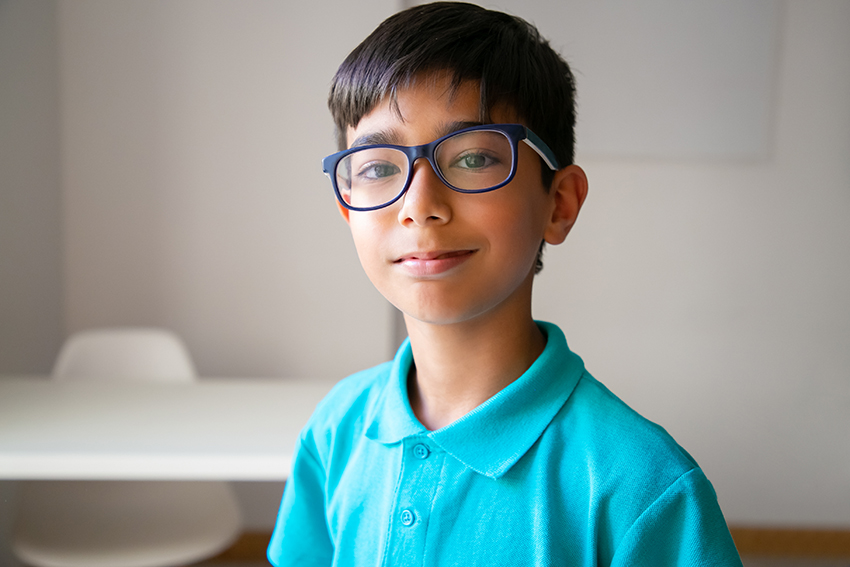
Have you noticed more children wearing glasses these days? Perhaps your child has started sitting closer to the television, squinting to see the classroom board or holding a book unusually close. Myopia, commonly known as short-sightedness, is becoming more common among children. And it’s a big concern many parents have.
Children’s daily routines have changed. They spend more time doing close-up work, less time outdoors and some may also have a family tendency towards myopia. At the same time, better awareness and eye screening mean vision problems are being found earlier.
Glasses may be prescribed for different refractive errors. Hyperopia or long-sightedness, can make closer works tough to be done in some children. Astigmatism can cause blurred or distorted vision at unlike distances. Whereas, Myopia makes distant objects look blurred.
In myopia, the eye usually grows too long and the light focuses in front of the retina instead of directly on it. This is why distant objects may appear unclear.
There isn’t one single reason. Several factors may be involved.
Think about a typical child’s day. There may be schoolwork, homework, reading, smartphones, tablets and gaming. Much of this requires the eyes to focus at a short distance for long periods. Longer periods of near work and screen use have been linked with a greater likelihood of myopia. How close the device is held and whether children take regular breaks may also matter.
However, this does not mean that every child who uses a phone or tablet will develop myopia. Even reading a book very close to the face for a long time is a form of near work. So, the goal isn’t to completely remove technology. It is to create a healthier balance.
This is an important factor that parents may overlook. Children who are spending more time outdoors are at lesser risk of developing myopia. Most likely the brighter outdoor light helps in regulating eye growth.
Children should spend around 90 minutes outdoor every day. Like walking, cycling or playing in the park or they should simply spend time outside.
Genetics also has a role. If one or both parents have myopia, a child has a higher chance of developing it. This does not mean that the child will definitely need glasses, but a family history can be a reason to monitor the child’s vision more closely.
This also explains why two children with similar routines may have completely different eyesight.
There is another side to the increase in children wearing glasses. Greater awareness, school screenings and improved access to eye examinations mean that children who have difficulty seeing are more likely to be identified earlier. In previous generations, some children may simply have lived with an uncorrected refractive error.
So, the increase in glasses does not necessarily mean that every child’s eyesight is becoming weaker. Some vision problems are simply being recognized sooner.
No, properly prescribed glasses do not weaken the eyes or make a child dependent on them. They help focus light correctly so the child can see clearly. Avoiding glasses will not train the eyes to become stronger. In fact, leaving a significant refractive error uncorrected can affect a child’s ability to see clearly at school and during everyday activities. It is seen in few cases that if refractive error is left untreated it might lead to amblyopia, commonly termed as lazy eye. So if an eye specialist recommends glasses, wearing them as advised is important.
Children do not always realize that their vision is blurry. They may simply assume that everyone sees the world in the same way. Keep an eye for signs such as:
These signs don’t exactly mean your child needs glasses, but they are good reasons to to get their eyes examined.
A few simple habits can make a difference:
The aim is not to make children afraid of screens or glasses. It’s about getting them to develop healthier viewing habits while their eyes are still developing.
When it comes to a child’s vision, early attention can make a real difference. Ojas Maxivision Eye Hospital has a team that includes specialists in paediatric ophthalmology and squint care, along with ophthalmologists and eye surgeons covering different areas of eye care. Ojas Maxivision Eye Hospital has centres in Bandra (West), Kandivali (East) and Juhu, making it easier for families to access eye care.
If your child is squinting, sitting unusually close to screens, struggling to see the classroom board or frequently complaining of eye strain, don’t simply assume it is because of too much screen time. A proper eye examination can help identify what is really happening.
Healthy habits today and timely eye care can help your kids with a clearer tomorrow.

